
Incident Summary US Air Force
Place and Time: The accident involved a U.S. Air Force KC-135 Stratotanker aerial refueling aircraft that was crashed in the western part of Iraq on March 12, 2026, at approximately 2:00 PM Eastern (local afternoon) The military and intelligence sources claim that the crash occurred on the border between Iraq and Jordan along the border at a place called Turaibil, include This was in the case of operation Epic Fury which is the war of the Americans against Iran.
Casualty: At least four out of six crew on board are confirmed dead. U.S Central Command (CENTCOM) indicated that four out of six aircraft crew members on board have been confirmed dead, and the rescue operation is still on going. Two more crewmen had initially been lost, and this led to a tactical recovery operation (also known as a TRAP mission) to find survivors or bodies. Names of the dead fellows were not disclosed until they were reported to the family members. The accident is also one of the most ghastly American aviation disasters in the ongoing war. Amazingly, the tanker did not have any ejection seats thus the survival of crewmen depended on the safe escape of the plane after it was brought down.
Preliminary Reaction: Rescue crews (U.S. and coalition) rushed to the scene of the crash to provide help. Helicopters and ground troops were deployed, rushing to rescue the location before other aggressive players could take action. Authorities said that it was a continuous rescue operation in friendly airspace. TRAP missions in the area are frequent, in this case involving the forces of neighbors to Kuwait and U.S. special operations units in response to an aircraft crash. At least one of the U.S. KC-135s that were involved in the incident landed safely by evening after declaring an emergency – it landed in Israel according to flight trackers
Aircraft Details
Aircraft Role: The aircraft was a Boeing KC-135 Stratotanker, which is the main U.S air tanker refueler. Stratotanker has served the USAF refueling needs for more than 60 years in total It enables fighter jets, bombers, and other planes to fuel themselves in the air and increase their coverage distance by a large margin. KC-135 is a modified Boeing 707 jetliner that has a flying boom operator bay at the tail. A boom operator operates a rigid boom manually to reach the receivers with the transfer of fuel. Certain KC-135s are also able to employ pods on planes equipped with probes.
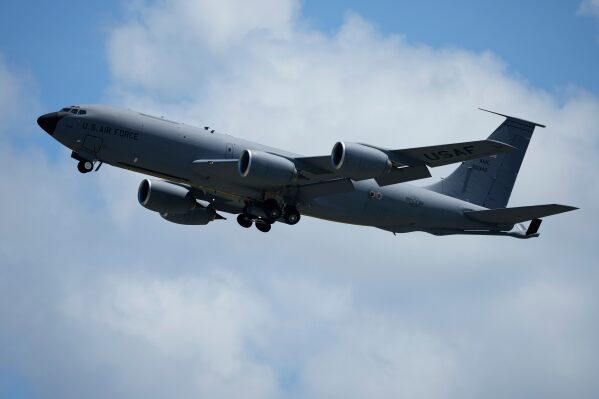
The Stratotanker is needed: it provides the U.S. aircraft with the global capability as it allows them to take long missions. U.S. Air Force, Navy, Marines, and even allies planes have been fueled by KC-135s at numerous conflicts These tankers are kept occupied in filling the strike jets heading to Iran or in the areas around its borders in Operation Epic Fury.
U.S. Air Force KC-135R Stratotanker (air refueling plane) at an air refueling station. The almost 60-year old KC-135 is being slowly phased out by the newer
History and Upgrades: The KC-135 was first flown in 1956 and put into service in the late 1It was originally designed to accommodate 732, and it was to be used until the newer KC-46 Pegasus came into use. In U.S. inventories today, there are approximately 376 that are active. The majority of them are equipped with new CFM-56 engine models. that makes them more efficient. A large number of KC-135s continue to be of Vietnam age, although they have had upgrades. Their flights are also thousands of hours a year. Programs of modernization have included improved communications, autopilots, and wiring to fit standard flight requirements. Officials project at least 2050 as the next time that KC-135s will be retired
Crew Composition: A standard crew on a KC-135 consists of three individuals a pilot, co-pilot and boom operator. On the back is the boom operator who is lying prone to refuel planes. The officials however pointed out that more crew was on board on this flight. It was said that there were at least five crew on board and that the number six was confirmed afterwards. Additional staff may be mission crew, technicians or trainees. The reason why additional crew were on this sortie is uncertain. There were the U.S. Air Force staff as well as perhaps allied/observer staff on the plane. Every soldier on board had his mission, and it is kept secret to the inquiry.
Setting: Operation Epic Fury and Middle East War.
The catastrophe occurred in the context of active military action of the U.S. against Iran. On 28 February 2026, the operation, Operation Epic Fury, was ordered by President Trump It is a broad-based attack to hit the Iranian military and nuclear targets. The US and its allies have attacked airfields, missile launchers, and command bases in Iran. Tankers such as the KC-135 featured in this overall war, they simply refuel combat jets that can fly deep into enemy territory. The further back the assets are moved, the further the planes of the U.S. have to fly, a process that is further enhanced by the necessity of aerial refueling
It is important to note that several American aircraft crashes have occurred before this. Only days before, the U.S. Air Force announced that three F-15E fighter aircraft were unintentionally shot down by Kuwait air defenses (friendly fire), though all six of the pilots ejected safely. The Pakistani Air Force also went missing during operation Epic Fury, and 5 U.S. nationals lost their lives in another Iranian drone attack on a port in Kuwait. Overall, before this crash, ten U.S. service members died in combat since the start of the Iran war All the incidents contribute to increasing the tension in the area, yet the death of a tanker with a large crew is particularly significant because it is hard to escape an aircraft such as the KC-135.
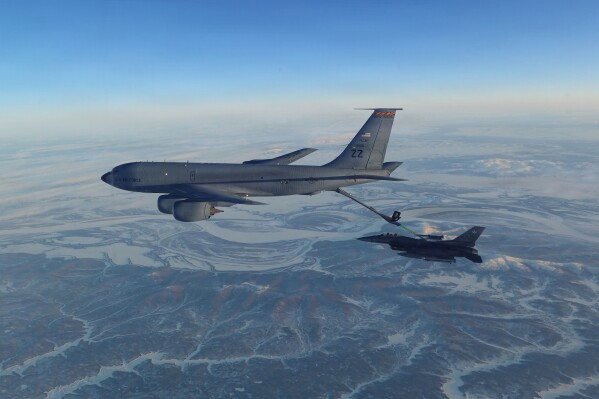
In 2026, an F-16 of the U.S. Air Force undergoes a fueling in Alaska by a KC-135 Stratotanker. Long-range air operations in a conflict, such as the Epic Fury, are made possible with aerial refueling because it enables such missions to have longer ranges
Authoritative Interventions and Responses.
CENTCOM Statement: U.S. Central Command issued a press release stating that it had lost a U.S. KC-135 refueling aircraft during its operation Epic Fury operation Significantly, CENTCOM said that it was not a friendly fire or hostile fire incident It reported that there were two airplanes in it, one of which landed safely, and the other one crashed in western Iraq CENTCOM never immediately determined the number of casualties, but requested the world to be patient since efforts are still being made to rescue The crash time (March 12, around 2 pm EST) and the four deaths were later confirmed by a more detailed CENTCOM statement (on social media) on the crash. The tenor of these utterances focused on the fact that the crash was taking place in friendly airspace in combat support operations
Pentagon and Other U.S. Officials: Defense officials had offered condolences to the families. The Secretary of Defense, Pete Hegseth, and military commanders rushed to assure people that there was no sign of enemy activity. Pentagon officials said that they were still investigating. U.S. officials speaking anonymously told the media that the accident could have been a mid-air collision between two. The flight tracking information indicated that the second tanker had reported an emergency and turned to Israel
Air safety experts in the United States stated that although mid-air collisions were infrequent, formation flying during refueling was dangerous.
Iraq Position: The Iraqi government has not yet come out in a detailed statement regarding the crash. U.S. forces must have informed local authorities about the rescue. Sources of Iraqi intelligence address the media, and confirmed the area around Turaibil and reported the urgency of search operations [(25+L143-L148)]. Formally, Baghdad has continued to hold that the U.S flights in Iraqi airspace are coordinated and the crash was a military accident. We have not heard foul play on the part of the civilian leaders in Iraq, but they are more troubled over the consequences and the inquiry.
Claims of Responsibility and Investigation.
Militia Claims: The tanker was shot down by some Iran-aligned militia groups, such as the Islamic Resistance in Iraq. Iraqi armed groups published messages (through Telegram) that they had shot down a KC-135 aircraft in western Iraq to protect sovereignty. IRGC sources were quoted by an Iranian outlet stating that missiles shot at the U.S. tanker, killing all its crew members. Nevertheless, American and coalition officials strongly reject aggressive fire. According to CENTCOM and independent analysts, there is no proof that the crash was caused by an enemy action. The claims by the militias are dealt with as propaganda by the U.S. military spokespersons.
Eyewitness and Media Accounts: Videos and posts on social media by eyewitnesses featured some videos showing a pilot parachute (which turned out to be an unrelated news of an F-15 collision). The U.S and Iraqi media announced that the plane went down after refueling another plane and was crewed by six people (KC-135) at the time the accident happened. FlightRadar24 showed that one KC-135 had declared an emergency. Analysts warn that initial reports on the battlefield may be conflicting. The media, such as Al Jazeera and CBS, regularly reported the events, giving regular updates, many of which were from anonymous officials. They emphasized that the official assessment does not include a shoot-down, awaiting an official crash investigation.
Investigative Leads: The initial military opinion is that a mid-air collision could have taken place in a refueling exercise. The in-flight refueling involves accurate formation flying, and when two tankers are not coordinated properly or hit wake turbulence, they could collide. Mechanical failure is also an option that is put in mind, considering the age of the KC-135. The U.S. Air Force has instituted an accident investigation board to conduct an analysis of wreckage, flight data, and crew communications. The cause has not been confirmed yet, but repeatedly officials pointed out that the loss of the aircraft was not as a result of hostile fire This implies that it is likely to have a mechanical or procedural cause.
History of KC-135 Crashes and Safety History.
Although aerial refueling accidents are uncommon, they have taken place in the past. An example is the case in 1966 in the Cold War when a U.S B-52 bomber crashed in the air over Palomares, Spain, into a KC-135 tanker. Four tankers were sunk, and the B-52 dropped hydrogen bombs that leaked and partly exploded (dispersed plutonium). That accident turned out to be a significant nuclear safety issue. Most recently, a KC-135 crashed on May 3, 2013, in Kyrgyzstan and killed all three crewmembers A board of the Air Force concluded that an instability (a rudder oscillation) in flight control resulted in a “Dutch roll” instability; trying to turn, the corrective inputs of the crew increased the oscillation and caused the tail to break off and blow up
But there were no crash cases of KC-135 within combat areas in 2013-2026. This, as given by Breaking Defense, seems the first KC-135 loss of the producing action since then safety in U.S. service has been enhanced through decades of retrofit. There are strict checks on the boom operator system, and crews are trained on in-flight emergencies. Refueling missions are usually off-ground threat missions. Maj. Gen. Scott Arquiette, the head of the crash investigation in 2013, has frequently pointed out that better training and procedures would have eliminated the chances of a repeat of that particular situation in the
The collision-avoidance systems and strict refueling protocols are also added to the modern KC-135s. With that said, the operational pace of the Epic Fury is very fast, which may cause stress even to well-maintained aircraft. The investigators are going to examine the maintenance records, pilot fatigue factors and weather or mechanical problems. The fleet of KC-135s remains safe due to its older fuel-system and guidance equipment, but with every accident, the questionable lifespan of the fleet remains.
Implications and Reactions
Military Operations: The strategic consequences of losing a tanker are felt. U.S. commanders can put the temporary shortening of sortie time or alternative tanker assets until they are informed of what transpired. The Air Force can divert more tankers on short-notice bases in Qatar or Kuwait. KC-46 Pegasus has been discussed as being deployed to the region sooner than originally planned in order to fill in any capability shortage, but KC-46s are scarce. All in all, the top brass has emphasized that the operations will go on–Epic Fury is laser-focused on mission objectives
Allied Concerns: The allies of the region including Bahrain and Israel have given condolences. They also depend on the U.S. logistics support. The amiable-fire assassination of F-15s had a tense effect with the Kuwait; but Kuwait has since officially announced an apology and assured improved security. The tanker crash is taken as an accident but not as an act of hostility which will contribute to the prevention of the further development of the conflict. The incident can prompt other countries that have U.S. forces to check the air-traffic coordination measures.
Public and Media: In the U.S., the tragedy was combined with media coverage that focused on clarifying that there was no sign of an attack. According to analysts, government propaganda is essential: naming the area as friendly airspace obstructs the retaliation of Iran. The crew’s families will be welcomed as heroes when the remains are returned. There have been solemn expressions of grief by the white house, and President Trump has again asserted that the U.S was committed to the mission, yet he warned that it may run the risk of further losses in war. Local citizens near Turaibil in Iraq claimed to have seen smoke because of the crash. A good number of the Iraqis are afraid of falling into the trap of the conflict, and some of them wonder why the U.S. has tankers flying within the Iraqi airspace in the first place. Iraqi leaders have not yet increased criticism, but rather recovery.
Frequently Asked Questions (FAQs)
Q: What was it that occurred during the crash?
On March 12, 2026, a U.S. KC-135 tanker was involved in an airplane accident in western Iraq in the area of the Jordanian border, during a refueling mission over Operation Epic Fury. Two tankers of the U.S. were flying together, one of which landed safely in an emergency, and the other sank. The event is under investigation. According to U.S. Central Command, the enemy or friendly fire was not the cause of the crash. The authorities believe that there could be a mid-air collision or an aircraft failure, but no reason is yet assured
Question: What was the number of crew on board and their fate?
A: The tanker that was downed had six crew members. CENTCOM then assured the death of four out of six. Two others had been lost at first; the search and rescue teams are still on the case, but they have not been publicly updated on their status. (Official announcements, as per the latest reports, have only revealed the four dead bodies, and rescue operations are underway) officials in the U.S. shall disclose identity within 24 hours upon informing next-of-kinds
Q: Is it the enemy that shot down the plane?
A: No. According to both the CENTCOM reports and the media reports, the crash was not caused by hostile fire Militia reports are unsubstantiated, and no report of enemy action. The space was a friendly airspace at the moment. The Pentagon has been responding to the incident as an accident, awaiting the official crash investigation.
Q: What is a KC-135 Stratotanker?
A: KC-135 Stratotanker is the primary aerial refueling aircraft of the U.S. Air Force. It is a large four-engine jet (after Boeing 707) that will inject fuel into combat airplanes on the move. It has been serving since the 1950s and offers global access to U.S. forces. An average crew is three (pilot, co-pilot, and boom operator)The KC-135s have been improved over the decades with superior engines and systems. KC-135s in the present campaign refuel fighters as they enter Iranian airspace.
Q: What is Operation Epic Fury?
A: The war against Iran organized by the U.S. on Feb. 28, 2026, is called Operation Epic Fury. It aims at destroying the offensive and nuclear capacities of Iran. This includes attacks on Iranian military facilities, missiles, drones, and military headquarters. U.S and allied troops have been in operation in the Middle East, particularly in Iraq and the adjacent seas. This tanker accident took place when the KC-135 was being used in this operation.
Q: What is, the prevalence of tanker crashes?
A: Air tanker accidents are extremely infrequent. KC-135 has been in the air for millions of hours; however, there are few fatal accidents. The previous U.S. KC-135 accident occurred in 2013 when a plane crashed in Kyrgyzstan because of a mechanical control failure. The refueling accidents are especially uncommon since the operations are usually well out of the combat areas. A well-known disaster involved the Palomares mid-air accident of 1966 (a B-52 collision) but this is a rare occurrence. Each incident is analyzed by the Air Force in order to avoid the repeat of the future.
Conclusion
In short, the American Air Force KC-135 tanker accident that happened in the west Iraq has taken away the lives of at least four Americans It happened when the air operations took place during Operation Epic Fury, it was established to have been amid friendly territory and not by the fire of enemy The officials at U.S. Central Command and other officials are handling it as an accident under investigation, which may be as a result of a mid-air collision or mechanical failure There are still search and rescue missions of the other crew members and the military is helping the families of the deceased.
Flight data recorders and flight wreckages will be looked into by investigators to identify the cause of the incident. However, the significant contribution of the KC-135 fleet in the process of refueling is crucial to the current missions. The restoration and renovation will be undertaken at an increased level of safety. The tragedy highlights the risks of aerial refueling as well as the risks that U.S. service members are at risk of supporting combat operations even when they are miles away.
Official sources like U.S. Central Command press releases should be followed by the reader to get the latest updates It is an evolving tale and the details provided will be updated as further information is revealed.