
NBA Playoffs Bracket
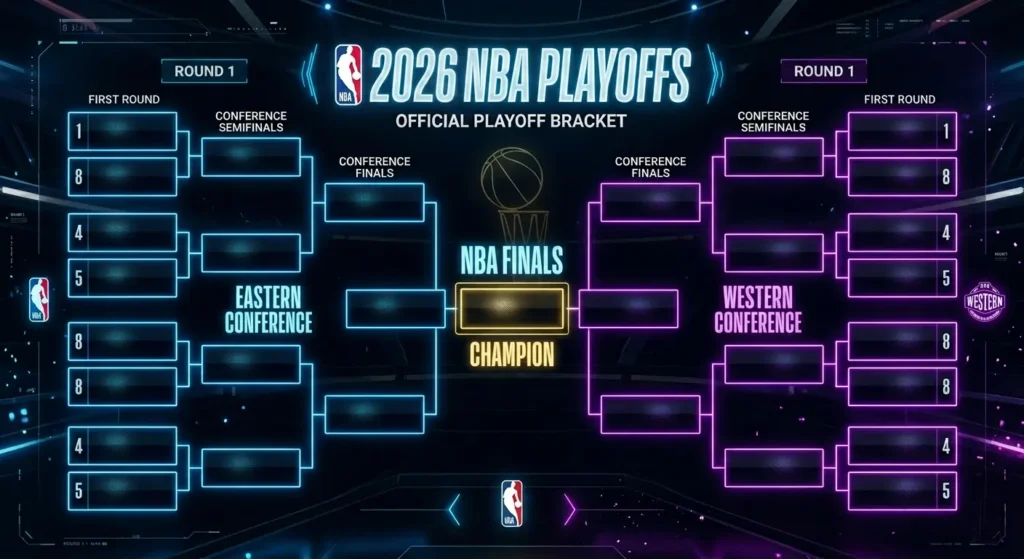
The NBA Playoffs Bracket is the most exciting roadmap in professional basketball, determining how teams progress from the regular season to the ultimate prize—the championship. Every year, fans closely follow the bracket to track matchups, predict winners, and witness the drama unfold as elite teams compete under intense pressure.
In this comprehensive guide, we break down everything you need to know about the NBA Playoffs bracket, including its structure, seeding system, key rounds, and how teams advance toward the Finals.
Understanding the NBA Playoffs Format
The postseason of the National Basketball Association features 16 teams, with eight teams from each conference—the Eastern Conference and Western Conference—qualifying based on their regular-season performance.
Each conference bracket operates independently until the Finals, ensuring a balanced and competitive progression. The structure is designed to reward consistency, giving higher-seeded teams an advantage through favorable matchups and home-court advantage.
How the NBA Playoffs Bracket Works
Conference Seeding System
Teams are ranked from 1 to 8 in each conference:
- 1st Seed: Best regular-season record
- 8th Seed: Lowest qualifying team
The matchups follow a fixed pattern:
- 1 vs 8
- 2 vs 7
- 3 vs 6
- 4 vs 5
This format ensures that the strongest teams face theoretically weaker opponents in the early rounds, while the competition intensifies as the bracket progresses.
Play-In Tournament: The Gateway to the Bracket
Before the official bracket begins, the league introduced the Play-In Tournament, adding another layer of excitement.
Teams ranked 7th to 10th compete for the final two playoff spots:
- 7 vs 8 → Winner becomes 7th seed
- 9 vs 10 → Loser is eliminated
- Loser of 7 vs 8 faces winner of 9 vs 10 → Winner becomes 8th seed
This system keeps more teams competitive until the end of the regular season and creates dramatic, high-stakes games.
Breakdown of Each Playoff Round
First Round (Quarterfinals)
The First Round features all eight teams per conference competing in a best-of-seven series.
- First team to win 4 games advances
- Higher seed gets home-court advantage
Upsets often happen here, making it one of the most unpredictable stages of the playoffs.
Conference Semifinals
The winners of the First Round advance to the Conference Semifinals.
Matchups are determined by bracket progression:
- Winner of (1 vs 8) plays winner of (4 vs 5)
- Winner of (2 vs 7) plays winner of (3 vs 6)
At this stage, the competition becomes more intense as only the top-performing teams remain.
Conference Finals
The last two teams in each conference compete in the Conference Finals.
- Eastern Conference Champion
- Western Conference Champion
These teams earn the right to compete for the championship, making this round one of the most watched in basketball.
NBA Finals
The final stage is the NBA Finals, where the Eastern and Western champions face off.
A legendary example is the dominance of players like LeBron James, who has consistently led teams deep into the playoffs and Finals appearances.
The Finals follow a 2-2-1-1-1 format:
- Games 1, 2, 5, and 7 at the higher seed’s home
- Games 3, 4, and 6 at the lower seed’s home
The first team to win four games is crowned NBA Champion.
Home-Court Advantage Explained
Home-court advantage plays a critical role in the bracket:
- Higher-seeded teams host more games
- Crowd support influences momentum
- Travel fatigue impacts lower-seeded teams
Historically, teams with home-court advantage have a higher probability of advancing, especially in closely contested series.
Key Strategies That Shape the Bracket
1. Depth and Rotation Management
Playoff success depends heavily on bench strength and player rotations. Coaches tighten rotations, relying on their best players for extended minutes.
2. Defensive Adjustments
Defense becomes more strategic:
- Targeting key scorers
- Switching defensive schemes
- Controlling pace and tempo
Teams that adapt quickly gain a major edge in the bracket.
3. Star Power and Leadership
Superstars often define playoff outcomes. Players like Stephen Curry have demonstrated how elite performance can carry teams through multiple rounds.
Historic Moments in NBA Playoff Brackets
The bracket has produced unforgettable moments, including:
- Underdog teams defeating top seeds
- Game-winning buzzer beaters
- Comebacks from 3–1 deficits
These moments highlight why the NBA playoffs remain one of the most thrilling sporting events globally.
How to Read an NBA Playoffs Bracket
Understanding the bracket is simple:
- Start with First Round matchups
- Follow winners advancing upward
- Track progression toward Conference Finals
- Identify the two teams reaching the Finals
Each step represents a higher level of competition, culminating in the championship showdown.
Predicting Outcomes in the Bracket
While unpredictability is part of the excitement, several factors influence outcomes:
- Regular-season performance
- Injury status
- Matchup advantages
- Coaching strategies
Analyzing these elements helps fans and analysts make informed predictions.
Why the NBA Playoffs Bracket Matters
The bracket is more than just a tournament structure—it represents:
- The culmination of an 82-game season
- A test of endurance and skill
- A platform for legendary performances
Every matchup tells a story, and every round raises the stakes, making the journey to the championship unforgettable.
Final Thoughts on the NBA Playoffs Bracket
The NBA Playoffs bracket is the heartbeat of postseason basketball. It combines strategy, talent, and drama into a structured path that ultimately crowns the best team in the league. From the Play-In Tournament to the Finals, each stage delivers high-intensity action and unforgettable moments.
Understanding the bracket not only enhances the viewing experience but also deepens appreciation for the complexities of the game. As teams battle through each round, the bracket transforms into a living narrative—one that captures the essence of competition at the highest level.