
How to Do Frog Pose for Beginners
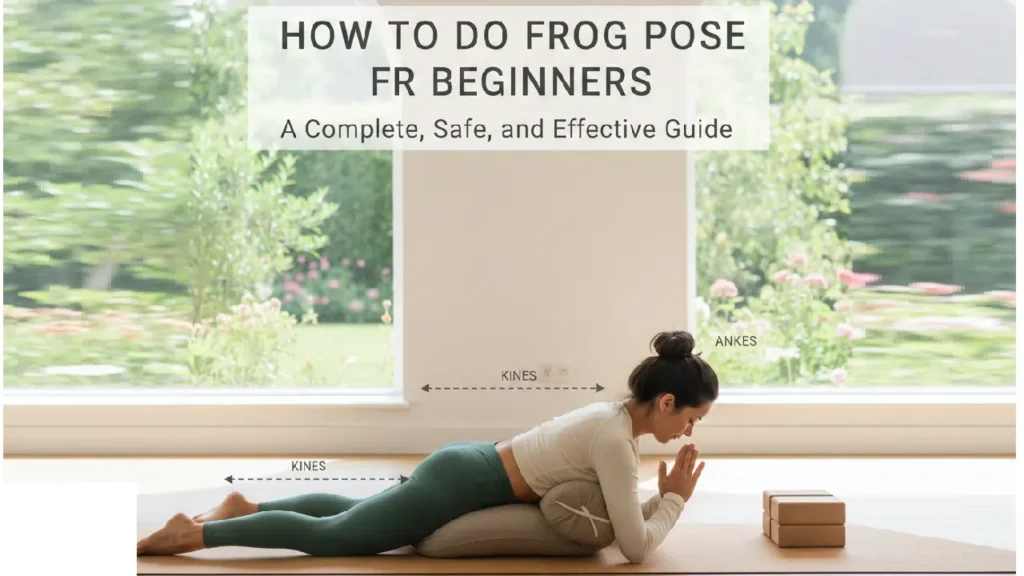
We also are providing a detailed step-by-step work out of Frog Pose (Mandukasana) aimed at the beginners who need to develop their hip mobility, inner thigh flexibility, and lower-body strength safely and efficiently.
Frog Pose is an effective floor pose which focuses on deep tissues in the hips and groin and facilitates improved posture, balance and functional movement. Practiced properly, it is an open, desirable, and transformational pose at all levels.
This guide provides simple alignment cues, breathing exercises, modifications, and progressions to ensure that beginners are able to practice in a confident and consistent manner.
What Is Frog Pose (Mandukasana)?
A deep isolation pose of the hips and performed on the mat, Frog Pose or Mandukasana is traditionally referred to as Mandukasana. The posture focuses on external rotation of the hips, stretching of adductors and stability of the pelvis. With the torso being grounded and the knees being turned outward, we develop space between the hips and inner thighs without damaging the spine.
Key focus areas include:
Hip flexors and adductors
Inner thighs and groin
Lower back support
Pelvic floor awareness
Advantages of Frog Pose to Novices.
The targeted and practical benefits of practicing Frog Pose as a beginner pose are only beneficial when they are done with mindful alignment.
Increases hip range of movement on a day to day basis and sporting activities.
Decongests tightness of inner thighs due to prolonged sitting.
Helps with the comfort of the lower-back with the aid of pelvic balance.
Improves body consciousness and respiratory control.
Makes the body ready to higher up hip poses.
Regular practicing makes us develop functional flexibility without straint.
Who Shall Practice Frog Pose?
We Frog Pose recommend to beginners who would like to:
Increase hip flexibility
Decrease rigidity of sedentary habits.
Enhance the mobility of squats, lunges, and seated exercises.
Fitness, athletic performance, support yoga.
Individuals who have knee sensitivity, new hip pain and/or lower-back issues should practice with modifications or professional instructions.
Learning to Do Frog Pose Like a Beginner: Step-by-Step.
These are the steps that should be followed to practice Frog Pose safely:
Step 1: Set Your Foundation
Start in a tabletop with all fours. Bend the wrists downward to the shoulders, and the knees downward to the hips. Lightly use the core to stabilize the spine.
Step 2: Open up the Knees Little by Little.
Gradually move the knees apart, with ankle equally in correspondence with the knee. Bend the feet in a manner that the underside of the feet is in contact with the mat. This cushions the knees and increases stability.
Step 3: Align the Hips and Spine
Bend the hips down in a neutral position. Do not overbend the lower back. The hips are supposed to fall naturally and not through force.
Step 4: Support the Upper Body
Bend the forearms to the mat or have the palms fixed to the ground in case of additional support. The chest is open and the neck is at ease.
Step 5: Breathe and Hold
Hold the pose for 20-60 seconds. Breathe slowly using nasal breathing and have hips release with every exhale. Be aware without entering into distress.
Frog pose Breathing Technique.
Frog Pose is effective in beginners when one breathes properly.
Breath in and make the spine lengthen.
Breath out gradually to help loosen hip.
Ensure a consistent flow in order to avoid tension.
Meditated breathing facilitates calming and less dangerous supple Northward flexibility.
Novice Adaptations of Frog Pose.
Safety is also a priority to us, using available modifications:
Use Props
Support the hips with a bolster or folded blanket of yoga.
Reduce the strain with blocks under the forearms.
Limit the Depth
Reduce the width of the knees(in case of limited flexibility).
With shorter hold time (practice).
Wall-Supported Frog Pose
Placing feet against the wall provides a way of controlling their position.
Keep light pressure without pressing the stretch.
These alternatives enable us to move forward in a gradual manner without infringing on the boundaries of the individuals.
Frog Pose It is easy to fall into these common traps.
To perform the Frog Pose properly, the following are the common mistakes to be avoided:
Pulling the knees apart against their will.
Still in complete collapse, rather than being neutral with the lower back.
Withholding the breath, which makes the tension greater.
Poor warm-up before getting into the pose.
Conscious adjustment guarantees the long-term profit and harm aversion.
What is the Time of Frog Pose?
For beginners, we recommend:
20-30 seconds initially
With experience, the duration is gradually increased to 60-90 seconds.
There is never time superiority over quality alignment.
Warm-Up Pose Pre-Frog Pose.
Body preparation increases comfort and safety. Effective warm-ups include:
Cat-Cow To mobilize the spine.
Butterfly Pose of inner thighs.
Low Lunge for hip flexors
Happy Baby Pose to open the hips lightly.
The correct warm-up would help in the easier transition to Frog Pose.
Cool-Down After Frog Pose
Releases Frog Pose is followed by our suggestion to ground postures:
Child’s Pose for relaxation
Spinal balance: Supine Twist.
Savasana to give the practice.
The muscular balance and nerve calm down are restored by cooling down.
Developments Once you have mastered Beginner Frog Pose.
When we feel comfortable we may examine:
Long holds that are deeper in breath control.
Rocking movements of fascia release.
Much more difficult hip openers like Lizard Pose or Fire Log Pose.
Get better with time to keep the joints healthy and stable.
What Is the Frog Pose Practice Frequency of Beginners?
We recommend a frequency of 2-4 times a week with the aim of achieving maximum results. Stability develops long term flexibility without excessive tensioning of the tissues.
Last Practice Advice to those who are beginners to Frog Pose.
Training on a non-slip yoga mat.
Do not be afraid to use props.
Maintain mindful breathing
Honor body variations day by day.
Frog Pose is enhanced by taking it slow and consciously.
Conclusion
This is an all-inclusive tutorial on Frog Pose that will teach beginners how to perform it correctly, its modifications, and breathing techniques to enable it.
Performing yoga in a conscious and regular routine allows us to discover a degree of higher hip flexibility, ease, and strength without being unsafe or unbalanced. Frog Pose does not entail the insistence of flexibility, but rather the establishment of space by means of intelligent motion.