
5 Yoga Benefits: Transforming Mind
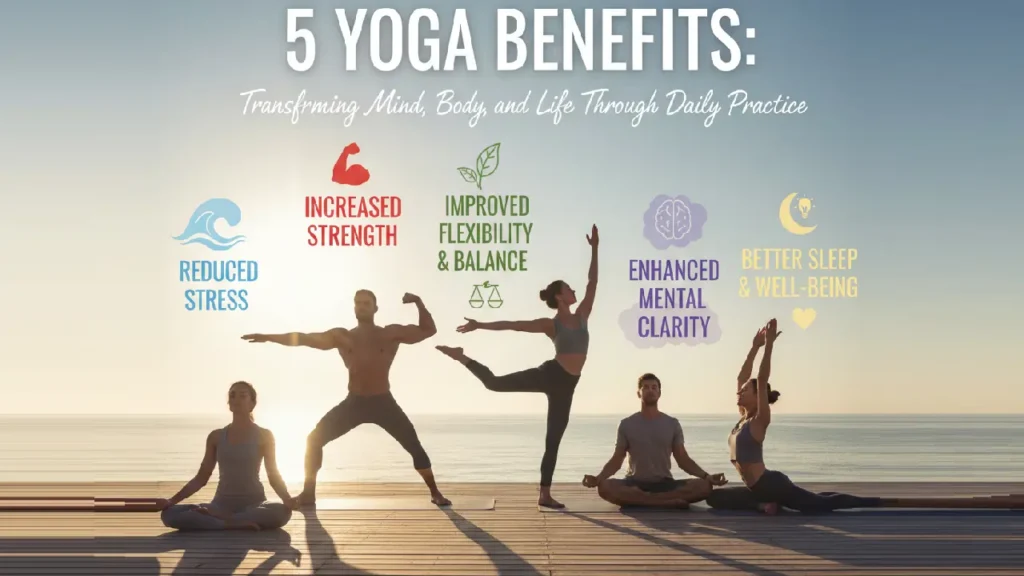
Yoga is not just a workout, it is a complete system which makes the body stronger, mind sharper and the emotional system brought back to balance. Yoga transforms our movement, breathing, thinking, and living, when it is a regular practice. We have listed the 5 most effective yoga benefits that provide real and quantifiable changes in personal health and wellness in this detailed guide.
With the incorporation of the organized body poses, conscious breaths, and conscious awareness we are accessing an energy, a clearness that many aspects of modern living tend to hide. The following will be a description of the radical nature of yoga on both flexibility, strength, mental clarity, stress reduction, and long-term health resilience.
Greater Flexibility and Greater Mobility.
Among the most well-known yoga benefits, there is better flexibility. But, flexibility does not mean just touching our toes, flexibility is restoring complete functional range of motion of muscles and joints.
Deep Muscle Elongation
The yoga poses stretch the muscle fibers, fascia and connective tissues gently. With time, these tissues become quicker and elastic thus becoming less hard. Yoga uses progressive pressure unlike high impact exercise which enables flexibility to be gained safely and in a sustainable manner.
Stability and Joint Lubrication.
The regular practice of yoga with different movements in different planes provokes the release of synovial fluid, which increases the lubrication of the joints. This minimizes friction and enhances painless movement. The stabilizing muscles are also strengthened by the balanced poses and these guard against joint injury.
Posture Correction
Sedentary lifestyles in the modern world usually result in stiff hip flexors, hump-shaped shoulders, and compressed backs. Yoga addresses muscular imbalances systematically through realigning of the spine and posture that alleviates sustained discomfort as well as enhancing physical presence.
Understanding of improved flexibility directly translates to better athletic performance, injury reduction and easier day-to-day movement.
Growth of Strength and Lean Muscle.
Although the concept of yoga is synonymous with stretching, it can also be used in the creation of functional strength. Resistance exercises in yoga poses use the bodyweight to work with various muscles in the process.
Full-Body Engagement
Standing to arm support Yoga engages the core stabilizers, butt, shoulders, legs and the back. This is a comprehensive involvement that produces balanced muscular growth as opposed to localized hypertrophy.
Stability and Endurance of the Core.
A lot of yoga designs require prolonged connection of the belly and back muscles. Close center of gravity helps in the support of the spine, promotes balance and overall movement efficiency.
Body Fat Free, but Toned.
Yoga is better at creating lean, long muscle fibers which enhances tone and stamina without being too hard on the joints. This leads to a chiseled body that is still active and practical.
The stronger a person becomes, the easier the daily activities are, better the performance in sporting activities and the efficiency of metabolism.
Less Stress and Improved Mental Sharpness.
One of the greatest yoga advantages is its effect on the mental health. Yoga provides a systematic way to the nervous system regulation in the age of hyper-stimulation and constant communication with the digital world.
Stimulation of the Parasympathetic Nervous System.
There is stimulation of the vagus nerve by means of the breathing techniques applied in yoga, and it transforms the body to the restorative state, not dominated by stress. This decreases the heart rate, lowers the blood pressure, and decreases the levels of the cortisol.
Centeredness, Balance of Emotions.
Present-moment awareness is developed through an intensive concentration in the yoga. This consciousness decreases rumination, worry, and responsiveness. The more we train the mind to be detached about thoughts, the stronger the mental resilience will be.
Better Concentration and Cognitive Ability.
Breathing under control enhances the delivery of oxygen to the brain making the person alert and more focused. Constant training enhances memory, decision-making capacity and concentration.
Yoga turns into some kind of a mental antivirus- purifying the mind fog and bringing back clarity after the sessions.
Improved Cardiovascular and Pulmonary Wellbeing.
Yoga also has a great contribution to the heart and lung work, especially when it is done dynamically or with controlled breathing.
Improved Circulation
Movement patterns enhance blood circulation, delivering oxygen and food to tissues and toxins to body tissues. The circulation is improved, leading to accelerating recovery and better cellular activity.
Reduced Blood Pressure and Heart rate.
Mellow inversions and tranquility poses encourage relaxation of the vascularity. In the long-term, regular yoga workouts would lead to stabilized blood pressure and decreased cardiovascular stress.
Expanded Lung Capacity
Breathing exercise conditions the intercostal muscles and the diaphragm. This increases the capacity of the lungs and efficiency of oxygen. Improved breathing power helps in endurance and decreasing fatigue.
The heart benefits attained with the help of yoga lead to long-term heart and vitality.
LLL, Long-term health, Longevity, and Immune Support.
However, there are more long-term benefits of yoga that have a long-term effect on the health of a person beyond short-term physical and mental effects.
Hormonal Balance
Balancing: The major hormones, including the cortisol, insulin, and thyroid hormones, get regulated with the help of stress reduction and regulation of the nervous system. Hormonal balance leads to consistent energy and metabolism.
Improved Sleep Quality
Yoga helps to relax the body and get a good sleep as it minimizes mental stimulation. Severe relaxation exercises are able to relax the nervous system, allowing one to fall asleep and sleep.
Stronger Immune Function
Less stress and better circulation increases the immune response. Regular exercise aids in the natural body defense mechanism making the body less vulnerable to diseases.
Healthy Aging
Yoga helps in healthy aging by keeping the body flexible, strong, balanced and clear minded. Lower inflammation and better mobility are the results in long-term independence and good health.
Other Transformative Yoga Advantages.
The five key yoga benefits are fundamental; however, there are other benefits that increase the effects of yoga.
Better Balance and Co-ordination.
Posture balance reinforces stabilizing muscles and redefines the neuromuscular communication. Increased coordination minimizes the risk of falls and increases the athletic performance.
Digestive System Support
Bending will stimulate the internal organs of the abdomen and ensure digestive efficiency. An increase in gut functionality improves the absorption of nutrients and energy.
Movement and Breath
by Detoxification.
Dynamic flows, and fined breathing helps the lymphatic system to eliminate the metabolic waste. During active sequences, as well, sweating helps with detoxification.
Embraced Self Discipline and Confidence.
The discipline and mental strength are developed through dedication to practice on a regular basis. Confidence grows into other spheres of life as the physical capabilities gain.
The Five Ways of Maximizing the Yoga Benefits.
The whole range of yoga benefits can be felt only when it is practiced regularly. Regular practices that are short and done in a daily manner tend to have a more long lasting outcome compared to a few lengthy practices done on rare occasions.
Establish a Routine
Habits of doing it daily at the same time develop momentum and strengthen the forming of habits.
Focus on Breath Awareness
Each posture should have breathing that is constant and controlled. Breathing awareness improves physical and mental effects.
Progress Gradually
Moving too fast may be straining. Slow improvements guarantee long-term enhancement and harm avoidance.
Integrate Power and Mobility.
Mixed classes comprising standing exercises, seated stretches, core exercises and relaxation are the most effective.