
My Secret Sarvangasana
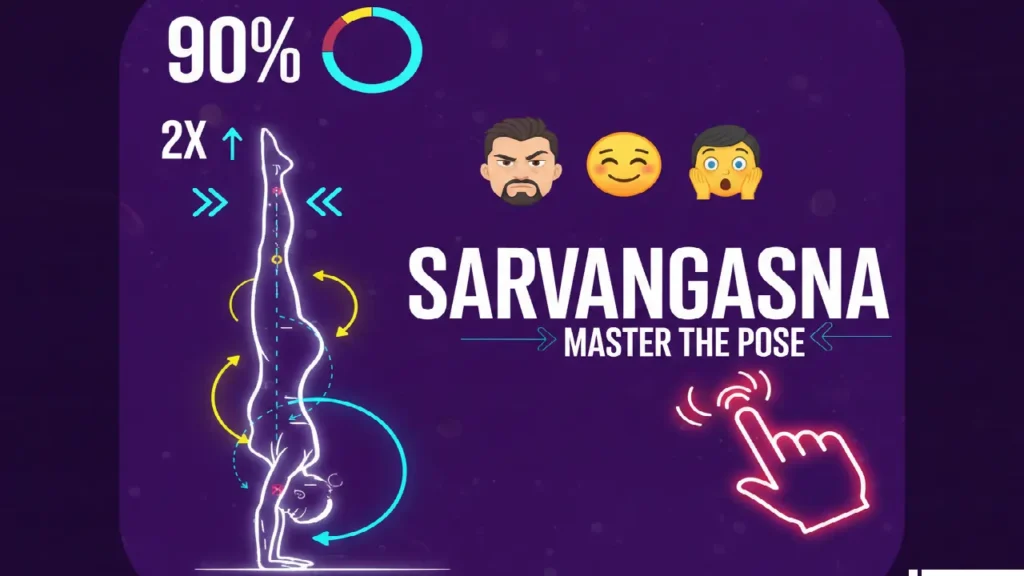
The first attempt that I made to do Sarvangasana, or Shoulderstand, I recall. I was actually sceptical, and my yoga teacher assured that it was a cure-all. My legs raised to the sky, I was lying on my back and felt awkward and unsure. However, something changed as I made myself a routine. I found out it was not merely a pose, it was a change.
Sarvangasana was my own magic potion, a silent protest against stress and exhaustion of the contemporary life. In this paper, I would like to tell you about my experience with this great asana and show you how to get the magic of this asana to work on your side.
What on Earth is Sarvangasana?
Sarvangasana is a foundational inversion yoga pose also known as the Queen of Asanas. Their name is in Sanskrit, Sarva signifies all, Anga signifies limb and asana signifies pose. It is, therefore, quite literally a pose across all the body parts. When I am in this position, the whole body is involved and reenergized even to my toes down to my crown.
Headstand, unlike its more well-known sister, Sarvangasana is normally regarded as more available and, in most aspects, more therapeutic. My shoulders bear the bulk of its weight, rather than my neck or head, and that is why it is a less dangerous inversion to the majority of practitioners, including myself when I was new at it. It became the basis of my individual practice, and its impact is immense.
Why I Swear By My Sarvangasana Practice: The Life-Changing Benefits.
I have not committed to this pose because of folklore, but because of the real benefits that have been achieved after week after week. This is what Sarvangasana has done to me:
An Increased Thyroid Activity: This is a huge one with me. The posture produces a slight squeeze on the neck area aiding in the stimulation of blood in the thyroid and parathyroid glands. This has been associated in its aid to regulate metabolism which in my case meant to have more consistent points of energy.
Better Circulation and Legs: I also used to have heavy and tired legs, as I spent too much time in the sitting position. By turning my body inverted, I can have the venous blood flowing out of my legs to my heart without any difficulty, and this makes my legs less swollen and achy. It is a kind of a re-set button to my circulation.
Less Frenzied Nervous System: My nervous system was always in fight or flight in the world of go-go-go. The effect of savangasana is so relaxing that it brings my body to a rest and digest position. Holding the pose takes several minutes, and when it is over, I get a feeling that my mind is quiet, and I am not anxious anymore.
Relief my Aching Back: The light traction this position provides my spine with has been a savior to my lower back stiffness. It opens up the vertebrae, takes the pressure off, and gives me the sense of length and space that I otherwise can hardly experience.
Improved Lung Capacity and Sinus Relief: Jalandhara Bandha or the chin lock which is a natural posture in a complete Sarvangasana, promotes deeper breathing and may aid in eliminating sinuses. After my practice, I think my breath is fuller and clearer.
The My Step-by-Step Guide to a Perfect Sarvangasana.
Do not start this kind of inversion or any new exercise, please, without consulting with a medical practitioner first. Do not take this pose at the moment in case of neck problems, high blood pressure or during menstruation.
Preparation: I begin by preparing two or three thick blankets into rectangles. I put them on top of my mat so as to support my shoulders. This height is essential to support my neck.
Lie Down: I lie down softly on the blankets making sure that my shoulders are on the blankets and my head is on the floor. My neck must be pain free and not compressed.
Bend and Lift: In this position, I keep my knees bent and my feet on the floor, press my arms, engage my core and swing my hips upwards, which bring my knees to face height.
Support My Back: I Put my hands on my lower part of the back, bringing the thumbs as close to the spine as my fingers to the kidneys. My shoulders are set at the width of an elbow.
Draw Upwards: When I feel confident, I straighten my legs slowly (towards the ceiling), extending to my toes. My weight is not on the neck or head, but on my upper arms and shoulders.
Breathe and Hold: I maintain a soft look, deep and steady breathing. I meditate between 10 deep breaths and 3-5 minutes, attending to my body.
To Release: I draw the knees back to my forehead slowly straightening out my feet and rolling the spine down vertebra at a time. I never, never fail to give it a counter-pose.
The Essential Follow-Up: My Non-Negotiable Counter-Pose.
I never, ever get out of Sarvangasana and simply sit up. This is a very important precaution. I never fail to jump into Matsyasana (Fish Pose). To do this I maintain my legs straight on a floor, my hands below my hips and slight arching of the upper back and rest the crown of my head on a floor.
This offers a counterbalance to the extreme flexion of the Shoulderstand, as well as in my neck and upper spine. I have a minimum of 5-10 deep breaths.
My Best Practices to a Safe and Effective Practice.
Listen to Your Body: It is my golden rule. I drop down in case I experience any sharp pain, particularly on my neck.
Concentrate on Position: I always make sure that my elbows do not stick out. Retaining them offers a level ground.
Don’t Rush: I created my holding time. It is quite alright to begin with 30 seconds. It is associated not with time, but with consistency.
Use Props: I continue to use blankets all the time. They do not indicate any weakness but rather intelligence.
Frequently Asked Questions (FAQ).
Q: I have a neck injury. Can I do Sarvangasana?
A: I would highly discourage it unless one is directly supervised by a qualified and experienced yoga therapist or physician. There is a high possibility of worsening the injury.