
Yin yoga for deep relaxation winter routine
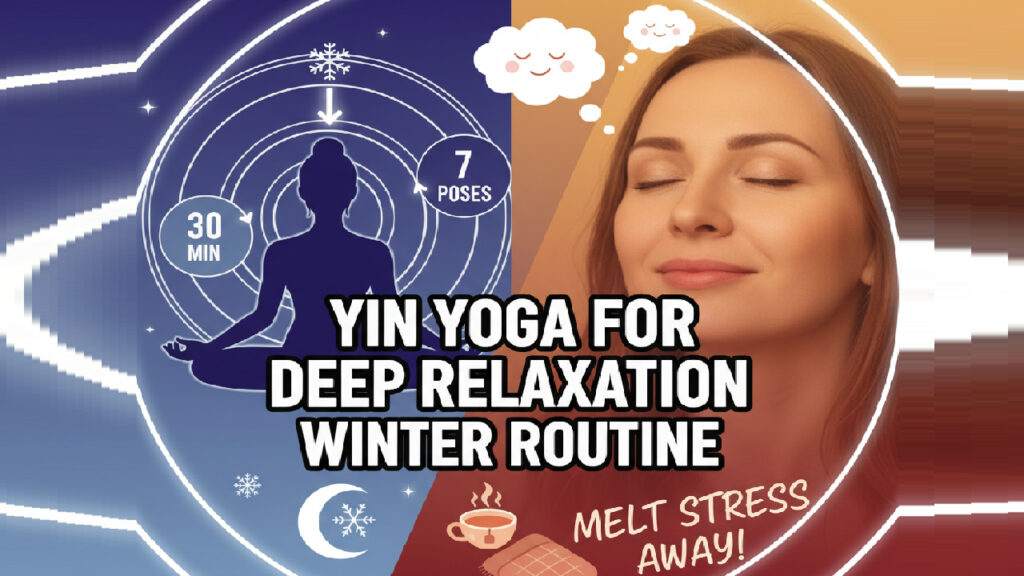
Traditionally winter is associated with the element of water and the energy of yin- slow, cold and receptive. The powerful vinyasa movement is good, but it cannot always respect the natural tendency of the body to rest during winter. That’s where yin yoga comes in.
The Magic of Long Stretches, Passive and Long.
Yin yoga is aimed at the deep connective tissues- the ligaments, fascia and joints, as opposed to muscles. Sustained stretching is achieved by performing gentle poses of three to five minutes that:
Purging the tension that is deep within and of which we are not even always conscious.
Enhances the circulation and range of motion of the joints, which otherwise would be impaired by coldness.
Relaxes the nervous system, putting the body out of the fight-or-flight mode into the rest-and-digest mode.
This is the final self-care when the world around is unkind.
My Winter Routine of Essential Yin Yoga to Deep Relaxation.
This is the very order I go through when I have to unwind physically and mentally. The only items required are a yoga mat, a roomy room, and some accessories such as pillows, blankets, or bolsters.
Pre-Practice Prep: They Warm-Up to the Scene.
I make a comfortable feeling even before I lay my foot on the mat. I turn the lights down, perhaps lay a candle and turn on some soft quiet, background music. This is aimed at making my body and mind aware that it is time to surrender.
1. Child Pose (Balasana) with Support.
Hold Time: 3-5 minutes
I begin on my hands and knees then proceed to bring my big toes and stretch my knees. Between my thighs I put a bolster or a pile of pillows, and lie down upon the torso in a complete position, with the head turned to one side. This pose is like a warm hug. It softly stretches my hips and lower back and promotes the sense of safety and submission. I turn my head to the other half.
2. Dragonfly (Ultimate Straddle)
Hold Time: 4-5 minutes
I sit on a bent back and make my legs open into a wide “V” position. I do not coerce it, the feeling must be slight. I put a bolster or some pillows before me, and hunch forward, lying all my torso on the support. The pose will work on the inner thighs and the spine. In my case, it is an effective lower back release and an excellent hip opening.
3. Supported Sphinx Pose
Hold Time: 3-4 minutes
On my belly I make myself rise on my forearms, with my elbows directly beneath my shoulders. I hold my neck stretched out and my head low. It is a mild backbend that assists in combating the hunching that we do during cold weather. It activates the lumbar spine and may seem so soothing to the soul.
4. aided Butterfly (Supta Baddha Konasana)
Hold Time: 5 minutes
This is where my winter routine will start. I lie on my back, and bring the soles of my feet together, and drop my knees away on the sides. I support each knee with pillows or blocks- this is important in a true release of the yin. I shut my eyes and put one hand over my heart and other over my belly. The pose is very beneficial because it opens the hips and the groin area and encourages a deep meditative position. I use it to relax away anxiety.
5. Legs Up The Wall (Viparita Karani)
Hold Time: 5-7 minutes
I slide my hips against a wall and bring my legs up and place them vertically. I put a folded blanket at the back of my lower back. Such is a magic inversion. It helps to de-tension my legs, calms down my nervous system, as well as alleviates any swelling in my legs and ankles in winter. It is as though it was a re-introduction to my whole circulatory system.
6. aided Savasana (Last Relaxation)
Hold Time: 5-10 minutes
I don’t skip this! I am on my back and have a bolster beneath my knees, and a blanket over me. I wrap my eyes using an eye pillow or a soft cloth. This is the place where the integration occurs. The practice transfers all its virtues to my body and my mind gets in a great state of deep winter rest.
Advice on Your Coziest Practice Yet.
Keep Warm: I would always have socks and a long-sleeved shirt. These passive poses cool the body to a great deal.
Make Abundant Use of Props: Support and Not Strain. Your friends in yin yoga are pillows, blankets, and bolsters.
Listening to Your Body: Pose: In case a pose feels sharp, get out of it. The pain must be a good pain–a far-off, drawn-out pain.
Breathe Deeply: my breath is my anchor. My breathing is long and slow so that my body melts into each posture.
Frequently Asked Questions (FAQs).
How frequently do I do this yin yoga practice?
I aim for 2-3 times a week. It is an ideal supplement to more vigorous exercises or a practice on free days.
I’m not flexible. Can I still do yin yoga?
Absolutely! Yin yoga is for you. It is not the distance that you can reach but your calm handicap and aids to hold you in.
At what time of the day is this practice best?
An evening practice is, in my opinion, a potent way of inducing a profoundly restful sleep. Nonetheless, morning session will provide an excellent relaxing atmosphere at the beginning of the day.