
My Journey to a Stronger Center: Why Core Yoga Poses Changed Everything
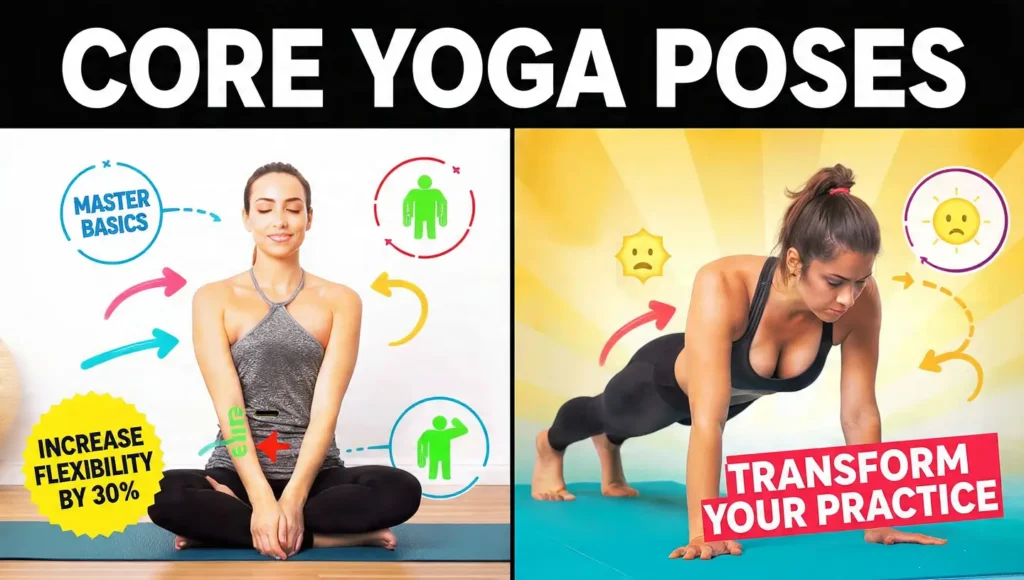
I will be frank, during most periods I believed that a great core was all about the acquisition of a six-pack. I would groan with endless crunches, and ask myself why I still felt pain on my lower back, and why my balance on the yoga floor was so unsteady. Only after I learned the actual reason behind core yoga poses, everything became clear.
My center, I discovered, is not only my abs, but my body engine, a sophisticated corset of muscles that goes around my whole body. In a 2023 study, the American Council on Exercise pointed out that core training such as in yoga, is much more effective at developing functional strength than isolation training alone.
I did not simply develop a flatter stomach through my concentration on basic core yoga poses, I gained a better posture, my back pain vanished, and I discovered some stability in my practice I never imagined would be possible. This is how I would have liked it done at the very beginning.
Core What Does Core Means in Yoga?
Most people, when we talk of core, would think of the surface level, the superficial, washboard muscles, the rectus abdominis. However, in yoga the definition is so extended and practical. The key to your body is your core. It contains the deep transverse abdominis (natural weightlifting belt) of your body, the obliques (sides), the multifidus muscles (along the spine), your pelvic floor and even your diaphragm.
Imagine that the center of your body forms the trunk of a tree. With weak roots, the tree is unstable as well and this is more so during the time that wind is blowing. Our wind is any action that we take, in our case we are climbing up to a top shelf, grabbing a child or a difficult yoga position.
Core yoga pose is meant to strengthen this whole system in an integrated manner whereby all these muscles are trained to work together harmoniously. That is why you cannot find a single crunch in this list. Rather, we work with more balance, stability and use of the entire body poses.
The Foundational 12: Your Guide to Core Pivotal Yoga Poses.
Want to create your powerhouse on the ground? Now, we shall explore the basic core yoga postures. I suggest that they should be practiced slowly and in a mindful manner. This is not an attempt to accomplish anything but to experience the light involvement of your deep abdominal muscles with every breath.
Plank Pose (Phalakasana)
This is the ideal core strengthener, and with reason. It shows your whole body to be one unit.
How to perform it: Begin on all fours, then push your legs behind you till your legs are straight. Your hands must be just in line with your shoulders and you must be in one straight line with your head down to your heels.
My Pro Tip: Do not allow your hips to sit or stick out! This is like pulling your belly button towards your spine and at the same time pulling your front ribs towards you. It is what really gets the inner flame going.
Why It Works: It utilizes the muscles of your transverse abdominis, rectus abdominis, obliques and even the muscles of your back and shoulders that ensure your back is straight.
Side Plank (Vasisthasana)
Plank happens to be your first-line defender, Side Plank is your expert, with the focus laid on the most frequently disregarded parts of the body: obliques.
How to do it: Starting with a normal Plank, move the weight to the right hand and the outside of the right foot. Place the left foot atop the right one and the left hip towards the ceiling, straightening out the left arm.
My Pro Tip: To make it easier, bend your bottom knee to the ground in order to have more support. The only thing is to hold your hips up– Do not drop them down on the floor!
Why it Works: It develops a tremendous power in your oblique muscles and the quadratus lumborum in your lower back, which is important in the stability of the spine.
The Pose of the Boat (Paripurna Navasana)
It is a straight talk to your inner soul. It is a difficult task, yet very successful.
The way to do it: Sit on the floor in a bent position. Sit up, placing your sitting bones, and keep your feet off the floor until your shins are at right angles with the ground. Extend your arms forward.
My Pro Tip: When your lower back arches, make your knees bend. It is aimed at making a long straight spine, not straight legs. Concentrate on pulling your low belly in and up.
Why It Works: It targets directly the hip flexors and the deep abdominal muscles and requires them to contract in order to maintain the body in a “V” shape.
Dolphin Pose
Imagine it is a forearm Plank that opens your shoulders- a two-in-one!
How to do it: Lie on your forearms using your elbows right below your shoulders. Lift your hips and draw your toes and create an inverted V shape with your body.
My Pro Tip Use the forearms to press hard and attempt to make your feet move a little closer to your elbows to incorporate more core and shoulder engagement.
Why it Works: It strengthens the shoulders and its result is that your core has to work to keep your torso erect.
Bridge Pose Setu Bandha Sarvangasana
The back of your body is known as the posterior chain which is an important component of your core! Bridge Pose strengthens the back and buttock.
How: Lie back, keep the knees bent, feet hip-wide and near the butt. Use your feet to press upwards to the ceiling.
My Pro Tip: Concentrate on glute squeeze on the top of the pose. This stabilizes the lower back and makes sure that the correct muscles are working.
Why it Works: It makes the glutes and erector spinae strong and play a crucial role in pelvic stability and high-quality lower back.
Bird-Dog ( Variation of Chakravakasana)
This is a master-class in anti-rotation and spinal stability despite the seeming simplicity of this pose.
How to do it: Start on all fours. Recline right arm straight forward with the leg straight back and them parallel to the ground.
My Pro Tip: It helps best to make sure that your hips and shoulders are at a perfectly 90-degree angle with the ground. Do not lean towards one side. Go slow!
Half Moon Pose (Ardha Chandrasana)
It is a deceptive core exercise. It is impossible to hold without serious oblique and deep abdominal involvement.
How to do it: Starting with a forward bends and stand, put your left hand on the ground (or a block) and raise your right leg right next to the ground. Lay your hips and chest on the side with your right arm stretched towards the ceiling.
My Pro Tip: Visualize that you are holding a ball in between your standing leg and your torso. It is this interaction that makes you not fall over.
Why it Works: It requires the obliques and the whole standing leg side-body to be highly stabilized in order to hold oneself in balance.
Warrior III (Virabhadrasana III)
A second pose of the balance that is a complete core wake-up.
How to do it: Starting in standing position, pick up one leg and hinge forward at your hips, and your torso and one leg will be in parallel position with the ground. Extend your arms forward.
My Pro Tip: Visualize your body as a seesaw, the hip is your fulcrum. On your standing leg engage your glutes and move your belly button into your core.
Why it Works: It is a test of your spine to hold your body straight despite the force of gravity and involves your back, glutes and abdominal muscles.
Chair Pose (Utkatasana)
This pose of the legs is no sham–a ruthless core worker, indeed, when you know what you are doing.
It works by having you stand and gently bend your knees and pull your hips back as though you were sitting in an empty chair. Raise your arms overhead.
My Pro Tip: To sit back, pay attention to making sure that your tailbone is tucked a bit and that you pull your lower abdomen in. This helps to ensure that your back does not overarch and instead makes your core hold the pose.
Why it Works: It involves the use of the whole abdominal wall to support an upright torso and safeguard the lower spine.
Forearm Plank with Knee Taps
This is what gives the Forearm Plank, otherwise a still pose, a dynamic motion, increasing the anti-rotational effort.
Instructions: Forearm Plank. Bring down one knee at a time slowly and carefully till you are touching the floor, and then put it back.
My Pro Tip: As still as possible with your hips. Your knee should only move; your body should not swing back and forth.
Why it works: It makes your obliques and transverse abdominis overtime to ensure your hips do not shift.
Downward-Facing Dog Knee-to-Nose.
Such a moving motion transforms a standard position to a belly-melting exercise.
Stroke: Starting with Downward-Facing Dog, inhale and raise your right leg into the air. When you breathe out, roll your spine round, and pull your right knee to the tip of your nose.
My Pro Tip: Rounding your back and involving your abdominals in pulling the knee in is the source of power, rather than the movement of the leg.
Why it Works: It is a combination of core strengthening and spinal flexion that replicates a crunch in a position more functional and weight-bearing.
Supine Leg Lowerings
An exercise that is inspired by Pilates and is painfully truthful as to your deep core strength.
How to perform it: Lie flat on your back keeping your legs straight upwards towards the ceiling. Gradually bend both legs downwards towards the ground ensuring that the lower back of the body is against the ground.
My Pro Tip: Raise your legs only so much that you do not arch your back out of the floor. When it curves, cease then–then is the extent of the core control that you have.
Why it Works: It twists the rectus abdominis and the deep core, creating an amazing control and stamina.
Making Core Yoga Poses a Part of Your Life.
You do not have to work on a separate core day. The best thing about these are the core yoga poses, as you can sprinkle them during your practice.
As a Warm-Up: You can begin with 3 rounds of Bird-Dog and 30 seconds plank to fire up your stabilizers.
Additional: Add a Knee-to-Nose in your Sun Salutations or spend five more breaths in Chair Pose.
As a Finisher: Finish your practice with a mini-core circuit: 30-second Boat Pose, 30-second Plank and 30 seconds on the Side Plank to the right and the left.
The Payoff: What to Expect
The transformations were radical when I made myself committed to these core poses in yoga. It did not happen one day, but in a couple of weeks, I realized:
No More Back Pain: my tightened core relieved the lower back of the strain.
Rock-Solid Balance: Poses such as Tree and Warrior III were unchallenging and stable.
Improved Posture: I automatically sat and stood erectly due to the training of my muscles to hold my spine.
More Power in Every Pose: My Chaturangas was more powerful, and my arm balances were at last attainable.
It is a process that is attained by establishing a core, rather than a destination. It is the act of turning up on your mat, hearing the body and relishing all the little and mighty action these underlying core yoga poses take. The future you will, the one who walks easily, gracefully, and with power will be grateful to you.
Frequently Asked Question (FAQ)
Q1: I have poor core and back problems. Will these be my safe poses in yoga?
A: You must always consult your doctor or physical therapist. On receiving the green light, begin with the most basic forms of the poses (such as Plank with knees down) and aim at form rather than time. The most essential rule is to listen to your body.
Q2: What are the frequency of practicing these basic yoga poses?
A: I would suggest you add some of them to your practice 3-4 times a week so that you can achieve the best results. It is much more important to be consistent than to have marathon sessions. Even a 5-10 minutes core work can make a tremendous difference.
Q3: I don’t see a “six-pack.” Do these basic yoga practices continue to work?
A: Absolutely! Exhibited six-pack muscles are mostly attributed to low body fat percentage. Whatever you are doing in these core yoga poses is occurring on a deeper level giving the functional strength which underpins the whole body, enhances your posture, and also removes injury. That is a far better prize.