
Movie Review Peddi (2026)
Rating: ★★★☆☆ (3/5)
Production House: Vriddhi Cinemas
Cast: Ram Charan, Janhvi Kapoor, Shiva Rajkumar, Jagapathi Babu, Divyendu Sharma, Satya, Boman Irani, Ajay Ghosh, Ravikishan, Tarak Ponnappa, Harish Peradi, Srikanth Ayyangar
Music Composer: AR Rahman
Cinematography: Ratnavelu
Editor: Navin Nooli
Production Design: Avinash Kolla
Producer: Venkata Satish Kilaru
Writer & Director: Buchi Babu Sana
Release Date: June 4, 2026
The Hype Factor
When director Buchi Babu Sana joined forces with Ram Charan for Peddi, expectations skyrocketed from the moment the first teaser dropped a year ago. With seasoned actors like Ram Charan, Jagapathi Babu, and Shiva Rajkumar themselves calling it among the finest works of their careers, the anticipation has only intensified.
Now comes the moment of truth: Does Peddi truly deliver on such sky-high promises?
The Plot
The story unfolds in a nameless Vizianagaram village during the 1990s—a settlement that technically doesn’t exist in any government record. The protagonist, Peddi (Ram Charan), works as a mercenary cricketer, lending his skills to whichever team pays him. His heart belongs to Achiyamma (Janhvi Kapoor), the daughter of the local sarpanch.
Enter Appalasuri (Jagapathi Babu), an idealistic villager whose sole dream is to bring a railway halt to their forgotten community. Despite years of unwavering effort, his goal remains unfulfilled.
What follows is Peddi’s transformative journey—how he inherits Appalasuri’s mission and pushes himself to extraordinary limits to make that dream a reality. The narrative explores how his wrestling prowess becomes pivotal to the struggle, the personal costs he bears, and his evolution from a hired athlete into a true sportsman. Guiding him through this metamorphosis is his mentor, Gavarnaidu (Shiva Rajkumar).
Will the village finally gain recognition? Can Peddi succeed where Appalasuri could not?
Performance Review
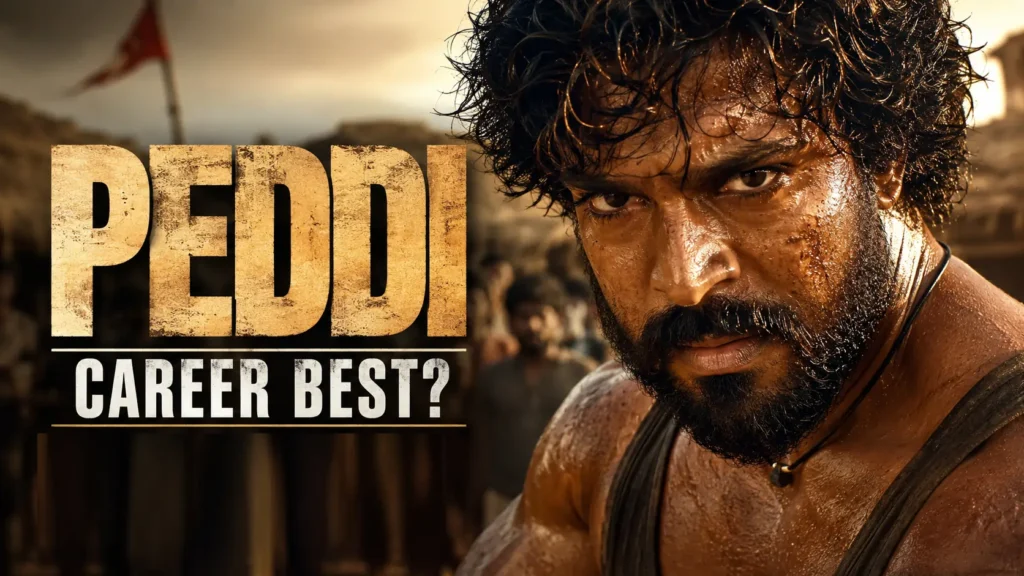
Ram Charan unquestionably delivers what may be the performance of his career. He disappears completely into the role—physically, emotionally, and vocally. Watching him excel as a multi-sport athlete is impressive, but his transformation into a wrestler is the true highlight. His final avatar as a runner is equally compelling. Charan undergoes a remarkable physical overhaul, and his Uttarandhra dialect rings genuinely authentic. The film largely rests on his shoulders, and he bears that weight with absolute conviction.
Jagapathi Babu, who terrified audiences as the ruthless antagonist in Ram Charan’s Rangasthalam, appears here in a radically different avatar. As a villager striving for his community’s development, he brings profound emotional depth, especially in the pre-interval sequences.
Kannada cinema’s beloved Shiva Rajkumar commands a substantial role and leaves a memorable impression. Janhvi Kapoor may not have a particularly meaty part, but she carries the village belle archetype with natural charm. That said, her character virtually vanishes in the second half.
Boman Irani‘s role feels largely unconvincing and poorly conceived. Despite a sprawling ensemble, most supporting actors get minimal room to shine. Satya goes largely unnoticed, while Rao Ramesh appears only in a few forgettable scenes. Ravi Kishan, Ajay Ghosh, Tarak Ponnappa, Harish Peradi, and Srikanth Ayyangar are given little of substance. Divyenndu, famed for Mirzapur, makes an impression early on, but his track ultimately leads nowhere.
Technical Craft
On the technical front, AR Rahman’s music and Rathnavelu’s cinematography are the film’s strongest pillars.
Two songs work effectively on screen, though the special number featuring Shruti Haasan fails to land as intended. However, Rahman’s background score elevates several crucial sequences and amplifies the emotional beats—though it stops short of being called “outstanding.”
Rathnavelu captures the sports sequences with flair and kinetic energy, making the wrestling and cricket segments visually thrilling. Avinash Kolla’s production design authentically reconstructs the period atmosphere.
The editing, however, proves inconsistent. The film struggles with pacing issues, particularly in the middle stretch where the narrative loses momentum. The writing also emerges as a notable weakness.
Strengths
- Ram Charan’s tour-de-force performance and physical transformation
- Two well-executed sports episodes
- A powerfully emotional final twenty minutes
Weaknesses
- Noticeable sluggishness in both halves
- Janhvi Kapoor’s poorly developed character track
In-Depth Analysis
Peddi marks Buchi Babu Sana’s second directorial outing following his successful debut Uppena. This time, with Ram Charan at the helm, the director scales up the canvas considerably. Although the film belongs to the sports-drama genre—a category Telugu cinema has explored frequently in recent years—Peddi distinguishes itself by incorporating multiple athletic disciplines rather than fixating on one. More importantly, Buchi Babu uses sports as a narrative vehicle to explore deeper social themes: identity, recognition, and the development of a marginalized village.
To establish the emotional conflict and the core issue that takes center stage from the interval onward, the director spends nearly an hour on conventional commercial tropes. Ram Charan is introduced as a cricketer for hire, followed by his romantic track with Janhvi Kapoor, accompanied by a couple of songs. Consequently, the first hour largely plays out like a formulaic mass entertainer.
Since Janhvi Kapoor’s character has little bearing on the second half, Buchi Babu seems to have front-loaded her role—giving her more screen presence and glamour in the opening portions before wrapping up the romance arc. The result is a subplot that often feels forced and occasionally veers into cringe territory.
The film finds its footing with the emotionally charged episode revolving around Jagapathi Babu’s character, who desperately fights for a railway halt for a village that doesn’t officially exist. The residents, lacking any legal recognition, are denied even a basic identity. This powerful sequence sets up the interval and propels the narrative into a far more engaging second half.
From Jagapathi Babu’s emotional track to Ram Charan beginning wrestling training under Shiva Rajkumar’s mentorship, these segments are handled effectively. However, the way Jagapathi Babu’s character arc concludes fails to evoke genuine emotion, as the character feels more functional and expository than truly moving.
While cricket dominates the first half, the second half initially appears to pivot entirely toward wrestling. But Buchi Babu introduces another twist by transforming Peddi into a runner. In this sense, the film presents Ram Charan as a rare crossover athlete, moving from cricket to wrestling to athletics. Although this progression is unique, the constant shifts between sports—combined with the extended village-development drama—create an uneven narrative rhythm. The film experiences several highs and lows, and this inconsistent flow detracts from the overall viewing experience.
The entire framing device involving Boman Irani stands out as one of the film’s weakest elements. The story unfolds as a flashback narrated to his character, a senior official from a government sports academy. Yet it strains credibility that such an official would be unaware of Peddi—a national champion who brought glory to India. This logical lapse weakens the narrative. Compounding the issue, the narrator occasionally reacts and shouts as though events are unfolding in real time rather than being recounted from the past. These moments feel contrived and add to the film’s many clichéd and illogical stretches.
It’s also difficult to fully accept the premise that an entire village could remain absent from government records simply because it lies at the foothills of a mountain, leaving residents without official identification. The film attempts to justify this by claiming thousands of villages still lack government recognition, but the execution remains unconvincing.
Interestingly, Buchi Babu employs a narrative twist that echoes a storytelling pattern seen in Uppena. Without revealing spoilers, Peddi’s life-altering setback and subsequent journey toward redemption bear similarities to the emotional structure of his debut film.
Although the screenplay frequently slips into predictable territory and suffers from pacing issues, Peddi ultimately stays afloat because of Ram Charan’s deeply committed performance and an emotionally stirring climax. The final stretch delivers enough impact to leave viewers with a positive impression despite the film’s shortcomings.
Final Verdict
Peddi is essentially a social message wrapped in commercial packaging. It is elevated by Ram Charan’s career-best performance, a deeply emotional climax, and a stirring musical score. Though logical flaws and pacing issues exist, Charan’s sheer hard work and dedication earn immense respect, making audiences overlook most of the film’s shortcomings. The final thirty minutes are profoundly moving and leave a lasting impact, adding tremendous value to the film. Ram Charan deserves every accolade for what is truly an award-worthy performance.