
My Journey to Yoga Poses for Beginners with Knee Pain
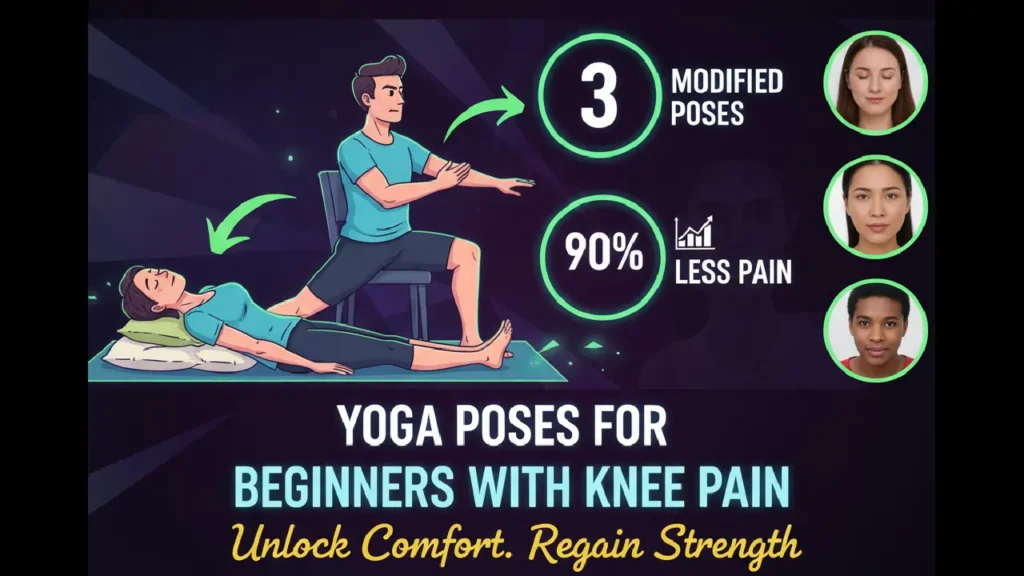
I understand that it is very frustrating. You will desire to begin a yoga practice of strength and peace, but each time you bend, your knees scream with the sharp pain. I was in that exact same place. The fact that I had my own knee pain, the remnant of old running injuries, led me to believe that yoga was not an option. But I was wrong. Because of thorough research and the collaboration with knowledgeable teachers, I found out that yoga, when taken with care, can be highly therapeutic.
This article is my guide that I would have preferred. I will tell about the basic, overall rules I applied to keep my joints safe and the specific, easy yoga exercises that are currently recommended to newcomers with sore knees and assist in getting their balance and relief. It is worth remembering that I am not a doctor, I am a student of yoga. It is always important to consult your healthcare provider on any new exercise program, and particularly in case you have pain or injuries.
The reason my knees hurt and how yoga can fix it.
The knee is a multifaceted hinge joint and the pain may be of so many sources: tightness of hips or hamstrings, weak quadriceps, or old trauma. In my case, the poor supporting muscles were the cause of my pains frequently.
I got to know that yoga does not impose anything on the knee; it makes the surrounding muscles stronger, and it forms a supportive natural brace. It also increases flexibility, which causes minimal stress on the joint in question. It is to just listen to my body, not to do painful ranges of movement, and make use of props, my greatest companions on this path.
My Golden Rules of practicing with knee pain.
The following are my non-negotiable rules which I adhere to in each and every practice.
Listening to Your Body: This is my motto. Suffering pain when stretching is one thing, but sharp, shooting, or pinching is another. In case I get pain, I retire at once.
Activate Your Muscles: I pay special attention to the active involvement of the muscles of my thigh, in particular, quadriceps, to support and stabilize the knee joint.
Mind Your Alignment: I would always make sure that my knees are aligned with the second and third toes. I do not allow my knees to curve in.
Take the Props without Apology: Strengths, straps, blankets, etc., are not crutches, but aids to smart practice. They have changed lives in my life as absolute game-changers.
Warm Up Gently: I never get into deep stretches. It is necessary to warm-up my muscles and joints.
My Favorite Gently Yoga Pose with Knee Pain.
These are the basic poses, which are the main basis of my practice. I proceed slowly and deliberately.
Constable Mountain Pose (Tadasana)
This is easy to figure out and I learnt how to be at the right place on the ground.
How I do it:
I am in contact with my big toes and a small distance between my heels.
I use my quadriceps, and the kneecaps are raised.
I bend my knees, making sure that they are not locked.
I shrug my shoulders backwards and down, and I stretch my back.
I take 5-10 deep breaths and I feel stable and rooted.
Why it helps my knees: It creates proper leg positioning and creates recognition of my standing position that safeguard my knees in all other positions.
Block Chair Pose (Utkatasana).
It is a quad-strengthener of a pose, but I make it knee-friendly.
How I do it:
I also put a block in between thighs and stand upright with feet being hip-width apart.
I squeeze the block as I make my knees bend and push my hips back.
I hold my weight in the heels and make sure that my knees are behind my toes.
I breath in 3-5 times, and concentrate on the work done in my thighs, and not on the squatting depth.
Why it works with my knees: As I squeeze the block, the inner thighs and glutes engage and this helps prevent the caving in effect of my knees which is the usual cause of pain.
Bridge Pose (Setu Bandhasana)
It is my favorite position to make my hamstrings and glutes stronger and not press on my knees.
How I do it:
I am lying on my back with bent knees and my feet turned flat towards the floor with hips at a distance of hip width.
I make certain that my knees are straight in line with ankle.
As I breath out, I push up my feet to pull my hips to the ceiling.
I sustain between 3-5 breaths with tightening of the glutes and then the downward movement.
In the case of my knees: Well-developed glutes and hamstrings are essential to hip stability, which directly influences the knee positioning during the walking process and other activities.
Assisted Reclining Hand-to-Big-Toe Pose (Supta Padangusthasana).
This will help me to reach my hamstring without damaging the sensitive structures of my knee.
How I do it:
I am on my back with both knees bent.
I put a belt around the foot arch on the right hand and straighten my leg in the direction of the ceiling.
I maintain the foot on the left flat on the floor or stretch the leg down the mat.
I tug at the strap, maintaining both hips to the ground. I never force the stretch.
I breath 5-8 positions on each side.
Why it will be good to my knees: Hamstrings which are tight can tug at the knee joint. This secure zone gets that tension out.
Virasana with Support.
It may be a severe position of the knees, though I provide lots of aids to make it available and healing.
How I do it:
I use a blanket or pile of blankets between my feet.
I sit softly on the support by bending my hips downwards.
When my knees put any strain on me, I place more height under my seat.
I count breaths of 5-10 with my attention to the comfortable stretch in my quadriceps.
Why it strengthens my knees: This pose offers a stretch of the quads under controlled and gentle tension and can enhance knee flexion with time. The trick is to get high enough so as not to feel pain.
Changes I Move With Caution.
Deep lunges and poses such as Pigeon Pose that involve high levels of external hip rotation are very conscious on my part in my practice. I always move very slowly into props and get straight out of them in case I experience any knee pain.